
This year Fr. Georges Conus celebrates fifty years of priesthood. The SMB was present in Haiti from 1972 to 2002. He arrived there as a deacon in 1975, ran the parish of Bombardopolis for eight years, then returned from 1994 to 2002 to the Cahos mountains. It was there that a secondary school was born – a school that still exists, and that he still watches over. We asked him to tell the story.
Why Haiti
Father Georges, how and why did the SMB come to Haiti in 1972?
The first thing to say is that the SMB’s vocation is to be with the most disadvantaged, with people living in poverty and destitution. And if there is one country in that situation, it is Haiti. Second, a group of lay missionary women from the Villa Beata was present in Haiti. Their spirituality is close to ours, so it was through them that we were asked to come. We committed ourselves to the first Haitian – native – bishop, and it was our confrere Ruedi Schmidlin, my former Bible teacher, who went first. My own first stay was as a deacon, in 1975-76.
“If there is one country in that situation, it is Haiti.”
You joined Fr. Schmidlin?
I joined Fr. Schmidlin in the diocese of Port-de-Paix, in the north-west of the island. He was the one who introduced us. But we each had a different commitment. Before that, he had been the only SMB member there, from 1972 to 1975.
When I arrived for a new SMB commitment, there were two young lay people: a nurse and a young mechanic, each working on a different project. All the same, we were trained together: an introduction to the language – Creole –, to the mentality, and to the various tasks in the diocese.
Learning Creole – how does one go about it?
In the afternoons we went down to the sea, barely a kilometre away. On the way, a crowd of children followed us and talked to us. It was with them that we learned the language best. After a month, I went to see a Canadian Father in the mountains, at the Jean Clair station. There was real poverty there, no electricity, no telephone – after school, the children played with me for half an hour, an hour, before going home. Two or three months later I came back. The catechists told me: “We didn’t dare tell you, but the first time you were here, you didn’t speak Creole very well. Now it’s wonderful.” They would never have dared to send someone away because of language difficulties.
“It was with them that we learned the language best.”
Ordination and Bombardopolis
You were supposed to be ordained in Haiti?
Yes, normally after two years as a deacon. But my mother fell seriously ill and had to have an operation. So I came back to Switzerland, and I was ordained a priest here on 3 October 1976.
And after your ordination you went back to Haiti?
Yes. From February 1978 I was parish priest of Bombardopolis. It is the westernmost parish in Haiti, facing Cuba. On a clear day you can see the Cuban coast, about 80 km away – much closer than the capital, Port-au-Prince.
I had a team with me: a catechist who trained the other catechists, a nursing assistant, and a teacher from the teacher-training college who supervised the small community and church schools of the area. Pastoral work and social development went hand in hand. I lived there for eight years, until 1986. When I left, the parish passed to the local clergy – which was exactly the goal we had been given on arrival.
“Pastoral work and social development went hand in hand.”
Four confreres in thirty years
Were there other confreres?
Yes. Brother Joseph Marclay, from the Valais – the only other French-speaking SMB member in Haiti besides me – who founded a vocational school with the Canadian Brothers of the Christian Schools; he died in an accident in 1989, at the age of forty-six. And Brother Albert Rusch, the fourth and last SMB confrere to serve in Haiti: he spent two or three years in Jean Rabel, then returned to Switzerland.
The Cahos mountains
And you yourself went back one last time in 1994.
Yes. From 1994 I returned, to the diocese of Gonaïves, under Bishop Emmanuel Constant, also a native bishop. I was then the only SMB member there. Ciliane Haselbach joined me in December of the same year, after a training period with E-Changer.
The bishop entrusted me with the parish of Chénot, the northernmost parish of the Cahos range. In the centre is the parish of Pérodin, and in the south that of Médor. The Cahos area has about 40,000 inhabitants over 600 km². When I arrived, 13 chapels depended on these parishes. The buildings were in poor condition. We repaired them little by little.
You returned to Switzerland in 2002.
Yes, in 2002, because of burnout. That was the official end of the SMB mission in Haiti.
And the fruit of the SMB in Haiti today?
There is a secondary school project that the SMB still supports today.
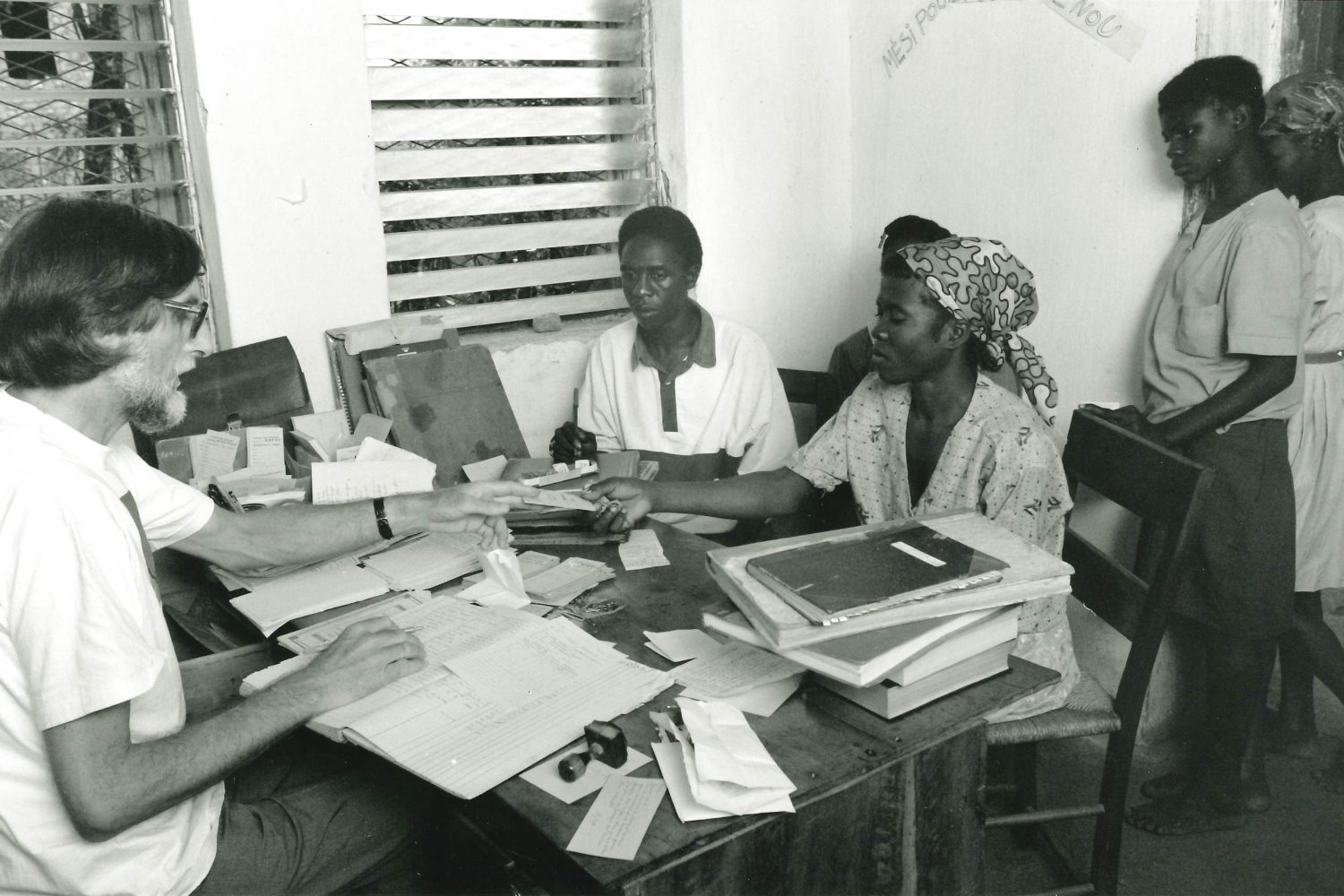
Haiti, Chénot: Georges Conus in the parish office.
Photo: Rolf Notter, 1995, SMB Archive, ref. V2b,9909
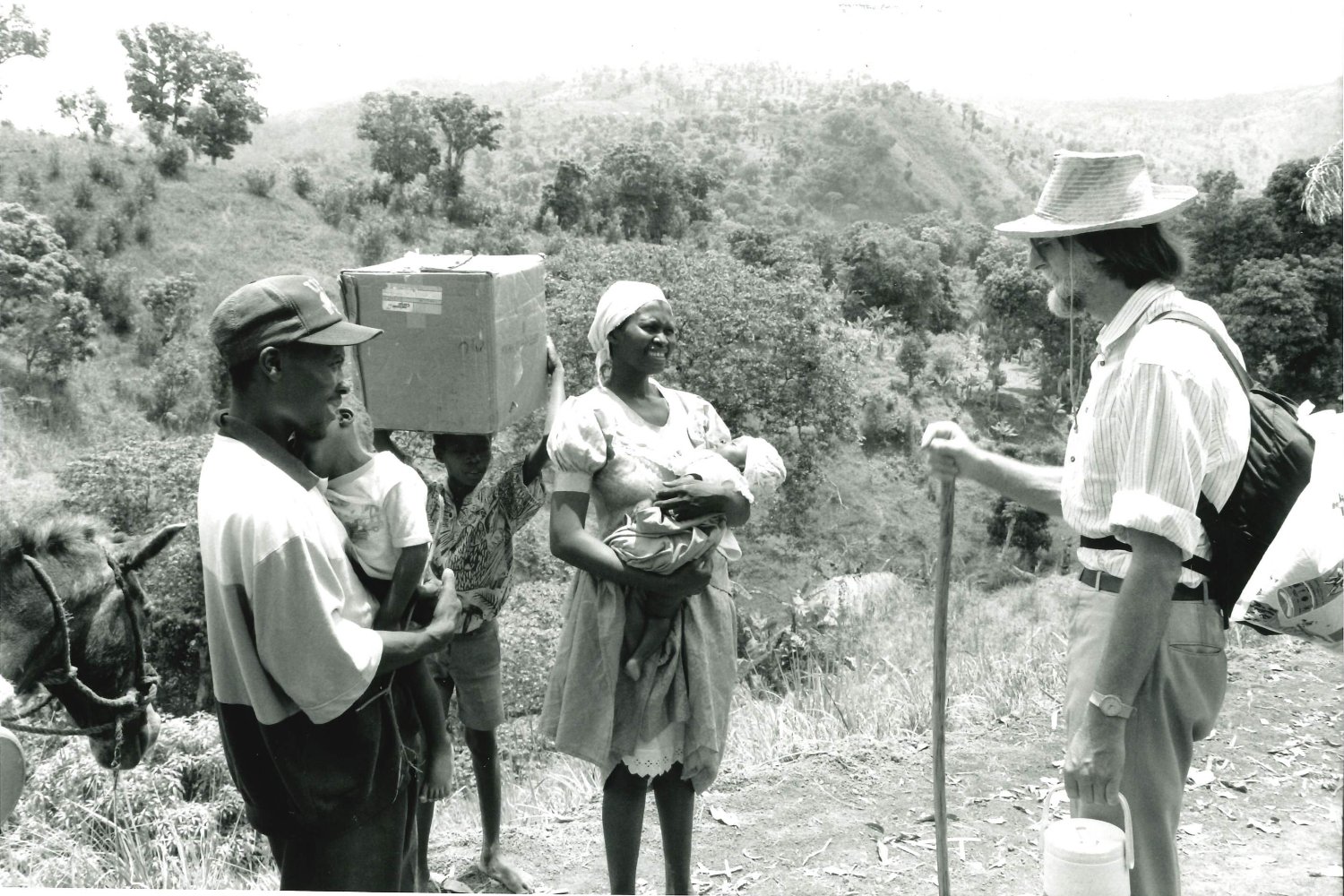
Haiti, Pérodin: Georges Conus meets a group of people on the way.
Photo: © CIRIC, J.-C. Gadmer, 1995, SMB Archive, ref. V2b,9918
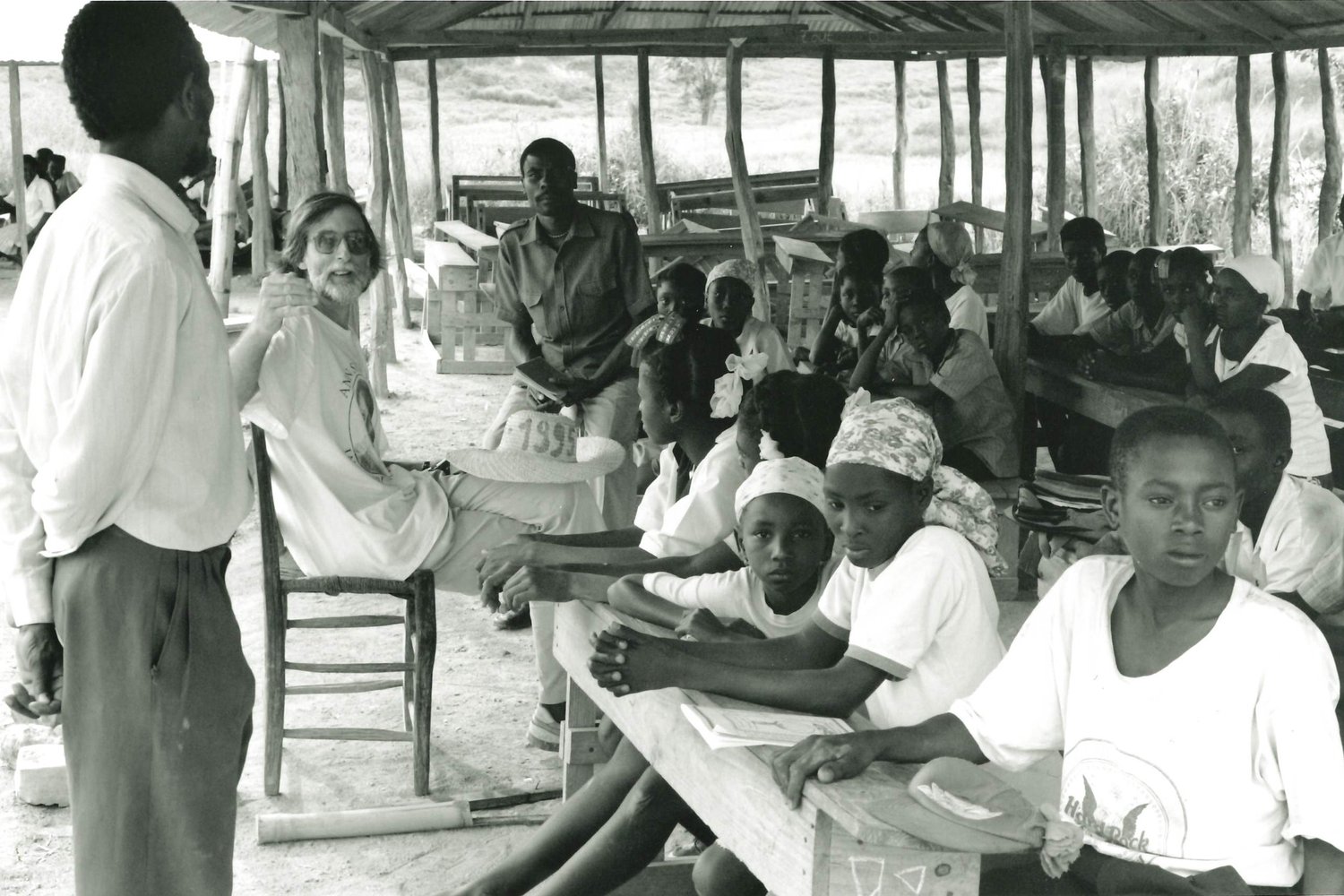
Haiti, Facoune: Georges Conus invites the young people to First Communion and Confirmation.
Photo: Rolf Notter, 1995, SMB Archive, ref. V2b,9911
A school for one dollar
In 1998, between Chénot and Pérodin, a school building stood unfinished for lack of money. The parish of Saint-Antoine-Ermite bought it for a symbolic dollar. It became the Collège Saint-Antoine de Bel-Air – but nobody calls it that. Fr. Georges had given it a short name, COSA BELA, and that is the one that stuck.
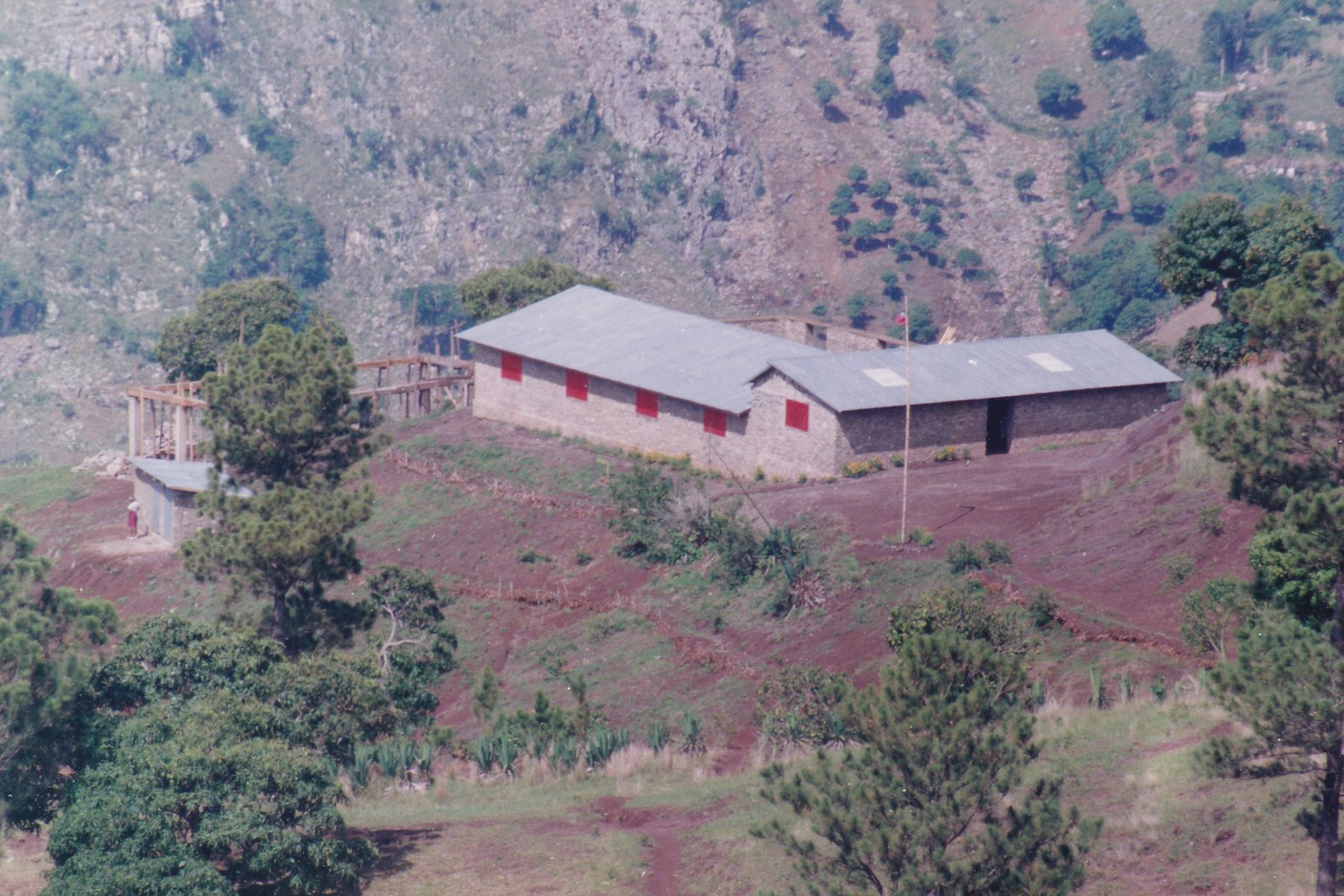
The COSA BELA school building in the Cahos mountains, Haiti.
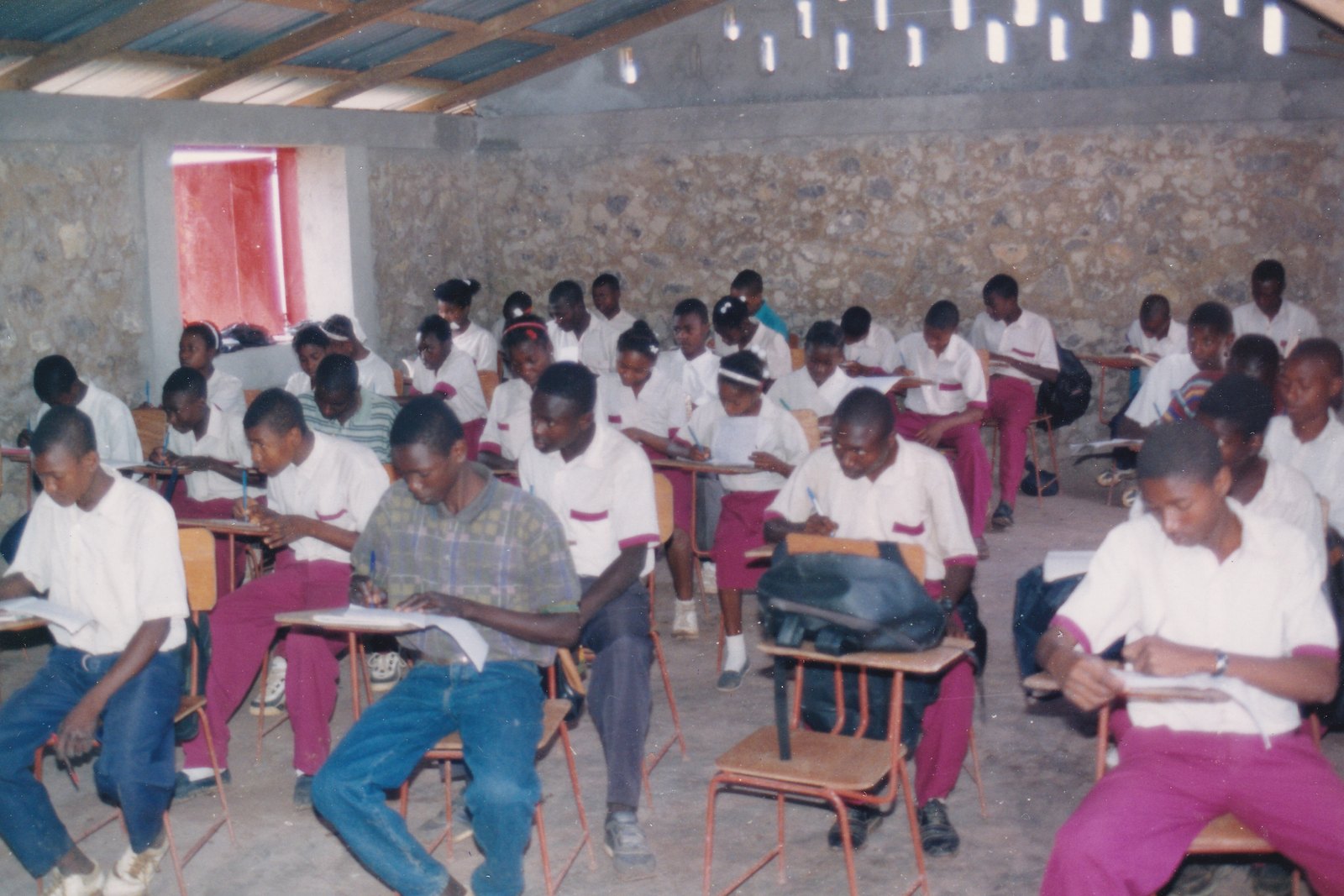
Pupils of COSA BELA during an exam.
The school covers the first three years of secondary education, the equivalent of the lower secondary cycle in Switzerland. At the end of those three years, it is clear whether a pupil can go on studying or should turn to a trade – for example at the vocational school founded a few years earlier by Brother Joseph Marclay.
The school has been run by Haitians from the very first day, and that was the principle: the SMB does not found the school, it supports the parish that carries it. But the fees paid by families cover only two months of the school year. Without help from outside, the school would close.
It has not closed. The SMB mission in Haiti ended in 2002; support for the school never stopped – and Fr. Georges still follows its funding, year after year.
The SMB in Haiti
- 1972 – Ruedi Schmidlin opens the mission in Port-de-Paix
- 1975 – Georges Conus arrives as a deacon
- 1978 – Bombardopolis
- 1985 – Schmidlin moves to Cap-Haïtien
- 1989 – death of Brother Joseph Marclay
- 1994 – return to the diocese of Gonaïves
- 1998 – the secondary school of Bel-Air
- 2002 – end of the mission
Four confreres in thirty years.
Haiti at a glance
- Population: about 10 million
- Baptised Catholics: about 70 %
- Practising: about a third of them
- Episcopate: entirely Haitian since the 1960s
