
Emmanuel Rubangakene, from Uganda, spent a year of Community Experience in Driefontein, then a month of pastoral experience at Serima Mission. He is now beginning philosophy in Harare.
A year at Driefontein
I spent one year at the SMB Regional House in Driefontein, Zimbabwe, for my community experience. Looking back today, I can confidently say that I am not the same person who entered this programme. This year has shaped me, challenged me, purified me and, above all, strengthened my conviction that I have found a place where I feel at home. The Child Jesus does not come into the world with power, status or worldly greatness, but in poverty and dependence. Through this spirituality, I learnt that true greatness lies in simplicity and availability to God.
There one learns the dignity of work. In the carpentry workshop I learnt to make simple furniture such as chairs and to repair doors. Together with my brothers and the kitchen staff, I prepared meals for the community. In the garden we planted maize and cared for the fruit trees. Community life can flourish even where there is no professional cook, carpenter or gardener.
My spiritual director, Fr. Roy, encouraged me to take a verse from Sacred Scripture each day, to reflect on it prayerfully and then to write a daily journal. Scripture stopped being simply a text to read and became a living encounter with God. Little by little I learnt to ask not only “What did I do today?” but, more importantly, “What is God revealing to me through today?”
A month at Serima Mission
Then came one month of pastoral experience at St. Mary’s Serima Mission in the Diocese of Gweru, founded in 1948 by Father John Groeber, SMB. Mission experience is often imagined as doing extraordinary things for God, but Serima taught me that God is often encountered in ordinary places, ordinary people and ordinary routines.
At Serima, daily life follows a rhythm of prayer, community and service. On Saturdays, Mass with the religious and village communities is celebrated in English and Shona, a reminder of the universality of the Church. Visiting the outstations, I saw faith flourishing far from the centre, and I discovered that pastoral work means going wherever the people are.
I taught children catechism, assisted the priest at the altar, visited the mission hospital and served in the priest’s house. The children’s questions pushed me to reflect more seriously on my own faith: one cannot transmit what one does not live. At the hospital I learnt that sometimes the greatest gift one can offer is simply presence.
In the mission garden I planted onions and tomatoes. I knew they would keep growing and serve the priest’s house and the community after my departure. Missionary life is often like cultivation: we plant, others water, and God gives the growth.
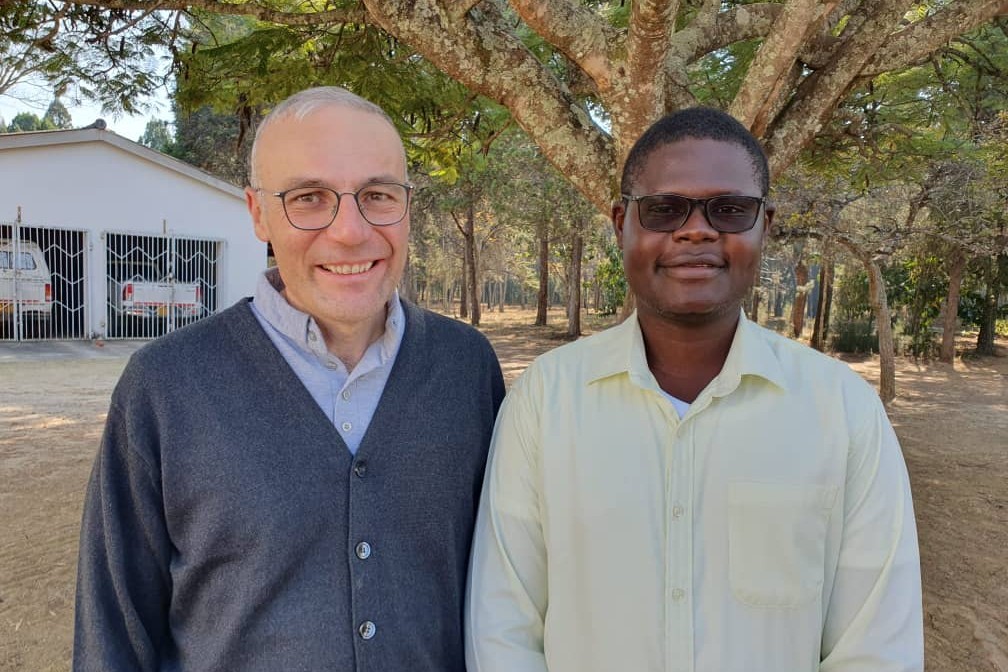
Emmanuel Rubangakene with the Superior General of the SMB, Ludovic Nobel.
Serima, my Bethlehem
The people of Serima welcomed me as one of their own; their faith, simplicity and resilience have become lessons to me. Often I arrived thinking I would bring something to others, yet I discovered that I was the one being formed. Serima has become my Bethlehem: here I am learning to become small with Christ and to serve quietly.
I entrust my vocation to this prayer: “Lord Jesus, make my heart like Bethlehem, simple enough to receive You, humble enough to serve others, and open enough to carry Your presence into the world.” I thank my formators and the Society for the opportunity to live all these experiences.
